Olaprixa Industrial
China’s wastewater sector is expanding, but sludge remains a difficult operational challenge. The China Urban Construction Statistical Yearbook shows China’s urban sewage treatment capacity has continued rising, creating more residual sludge for treatment and disposal. More wastewater does not automatically mean better sludge management. It means tighter process control.
For plant engineers, what is the difference between sludge thickening and dewatering? Thickening increases solids concentration and reduces sludge volume. It may use gravity tanks, dissolved air flotation, or rotary drum equipment. Dewatering removes more water and produces a transportable sludge cake. Common technologies include belt filter presses, centrifuges, and screw presses. The distinction is practical. A thickened sludge stream may still behave like liquid. A dewatered cake can often be conveyed by a screw or loaded into a truck.
The Water Environment Federation’s Manual of Practice No. 8 identifies solids handling as a major part of wastewater treatment design and operation. It also emphasizes polymer selection, feed consistency, and equipment loading. UN-Water’s World Water Development Report 2017 estimated that more than 80% of global wastewater was discharged without treatment. That figure shows the wider pressure on treatment systems, though it does not describe every Chinese facility. Conditions vary widely.
In the field, a centrifuge may produce a compact cake, yet consume more electricity. A belt press may use less power, but require careful wash-water management. The boundary is not always clean. Thickening can improve dewatering, but poor sludge conditioning can undermine both processes. Reliable comparison therefore requires solids concentration, dry-solids capture, cake dryness, energy use, and disposal costs. Performance depends on the sludge.
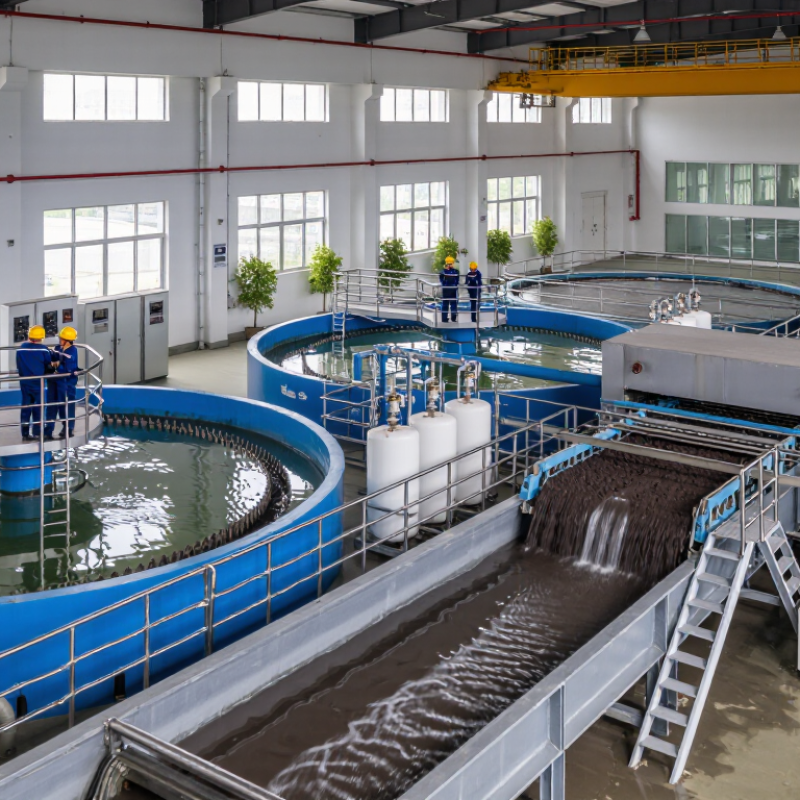
Sludge thickening is the process of removing part of the liquid from sludge before further treatment. It increases solids concentration while keeping the sludge pumpable. A dilute flow may contain less than one percent solids. After thickening, it may become several percent solids, depending on its source and equipment.
In China, thickening is widely used in municipal and industrial wastewater plants. It reduces the volume entering digesters, storage tanks, or dewatering machines. This can lower energy use and improve daily handling. Gravity tanks often suit heavier sludge with good settling properties. Dissolved air flotation can help with lighter biological sludge. Mechanical thickening is useful where land is limited, especially in crowded urban facilities.
Thickening is not the same as dewatering. Thickening produces a concentrated slurry. Dewatering creates a much drier cake for transport or disposal. The difference matters during equipment selection. Operators should test settling speed, polymer demand, temperature, and seasonal sludge changes. A chemical dose that works in winter may perform poorly during summer storms. This is easy to overlook. Field results also depend on mixing, feed consistency, and operator adjustment. No single method fits every Chinese plant, and relying only on textbook figures can lead to disappointing performance.
Sludge thickening removes part of the free water and typically raises total solids from about 0.5–1% to 3–6%, reducing the volume that must be treated. Sludge dewatering removes substantially more water and commonly produces a filter cake containing about 18–30% total solids. In China, thickening is often used before digestion, stabilization, or mechanical dewatering to reduce equipment load, energy use, and transport volume. Actual results vary with sludge type, polymer dosage, equipment, and operating conditions.
Sludge thickening raises solids concentration before treatment, while dewatering removes much more water. The difference is operational, not merely mathematical. Thickened sludge may reach about 3–8% total solids, according to US EPA’s Sludge Treatment and Disposal technical guidance. Dewatered cake often reaches 15–30%, depending on sludge type and equipment.
How sludge thickening works varies by feed characteristics. Gravity thickeners use settling and usually suit heavier biological or primary solids. Dissolved-air flotation lifts lighter particles with fine air bubbles. Rotary drum screens and gravity belt thickeners use drainage, mixing, and polymer conditioning. Typical equipment includes a feed pump, flocculation tank, scraper, polymer system, and solids discharge mechanism. The main outputs are concentrated sludge, separated liquor, and measurable changes in flow rate.
The US EPA’s Belt Filter Press fact sheet reports cake solids commonly around 12–30%, but results depend heavily on conditioning and operator control. A dry-looking cake is not always a better cake. Excess polymer can increase cost and contaminate recycle streams. Poor mixing can leave wet pockets. I would treat published ranges as design references, not promises. The Water Environment Federation also emphasizes testing sludge rheology, settling, and filtration before equipment selection. Small pilot trials reveal problems that spreadsheets often miss. Keep sampling. That step is easy to skip.
| Comparison Dimension | Sludge Thickening | Sludge Dewatering | Practical Significance |
|---|---|---|---|
| Primary purpose | Increase solids concentration by removing part of the free water. | Separate additional water to produce a transportable or manageable sludge cake. | Thickening reduces liquid volume; dewatering produces a more solid material. |
| Typical feed solids | Approximately 0.5%–3% total solids, depending on sludge source and collection process. | Commonly about 2%–8% total solids after thickening, although the design range varies by equipment and sludge type. | Stable feed concentration improves polymer conditioning and dewatering performance. |
| Typical outlet solids | Approximately 2%–8% total solids for many municipal applications. | Often about 15%–35% total solids, depending on sludge characteristics and the selected process. | Actual results require pilot testing because biological, chemical, and industrial sludges behave differently. |
| Main water removed | Free water that can separate relatively easily under gravity, flotation, or gentle mechanical action. | Capillary and interstitial water that requires pressure, shear, drainage, or filtration. | Dewatering is more energy- and equipment-intensive because the remaining water is more tightly held. |
| Common process methods | Gravity thickening, dissolved-air flotation, rotary drum thickening, and centrifugal thickening. | Belt filter pressing, screw pressing, filter pressing, centrifugation, and drying beds. | The best method depends on sludge type, capacity, land availability, labor, energy, and disposal requirements. |
| Typical equipment | Gravity thickener, dissolved-air flotation unit, rotary drum thickener, or thickening centrifuge. | Belt press, screw press, recessed-chamber filter press, plate-and-frame filter press, or dewatering centrifuge. | Ancillary systems may include feed pumps, polymer preparation, mixers, conveyors, filtrate return, and odor control. |
| Polymer requirement | May be low or unnecessary for gravity thickening; flotation and mechanical systems may require conditioning. | Frequently requires polymer or another conditioning method to improve floc formation and water release. | Dose must be optimized through jar tests or pilot trials to balance cake dryness, filtrate quality, and operating cost. |
| Hydraulic loading | Generally high liquid flow because the sludge contains substantial water. | Lower liquid flow after thickening, but higher solids loading per unit of treated volume. | Thickening upstream can reduce the size and hydraulic load of downstream dewatering equipment. |
| Solids recovery | Often high, but fine solids may remain in the overflow or flotation filtrate. | Typically designed for high solids capture, with liquid sidestream returned for treatment. | Capture efficiency is affected by particle size, polymer selection, shear, screen or filter condition, and operating settings. |
| Space requirement | Gravity units may require substantial surface area; compact mechanical units require less land. | Mechanical systems are generally compact, while drying beds require considerably more land. | Site constraints often influence the choice between gravity, mechanical, and natural processes. |
| Energy demand | Low for gravity thickening; moderate for flotation or mechanical thickening. | Moderate to high for mechanical dewatering, with energy use varying by machine type and throughput. | Energy should be evaluated together with polymer, wash-water, maintenance, and sludge-disposal costs. |
| Main liquid output | Thickener overflow, filtrate, or clarified supernatant. | Filtrate, pressate, centrate, or screw-press liquor. | These streams may contain soluble organics, ammonia, phosphorus, and suspended solids and usually require return treatment. |
| Main solids output | Thickened sludge that remains pumpable and is commonly sent to digestion, stabilization, or dewatering. | Dewatered cake or stackable solids suitable for storage, transport, further drying, reuse, or disposal. | Final handling requirements determine the target cake solids and acceptable consistency. |
| Pumpability | Usually remains pumpable, although viscosity increases as solids concentration rises. | Cake may no longer be pumpable and is commonly moved by conveyor, container, or front-end loader. | Transfer equipment must match the rheology of the thickened sludge or dewatered cake. |
| Typical operating objective | Reduce sludge volume and equalize solids loading for downstream treatment. | Maximize cake solids and solids capture while maintaining reliable, economical operation. | The optimum is not always the driest cake; it is the best balance of disposal cost, throughput, and operating cost. |
| Process relationship | Often used as a pretreatment step before digestion or mechanical dewatering. | Usually follows thickening, digestion, or stabilization when lower sludge volume and easier handling are required. | A combined thickening-and-dewatering line can reduce downstream equipment size and total sludge-handling volume. |
Sludge dewatering removes water from sludge and produces a denser, easier-to-handle cake. It differs from thickening, which mainly increases solids concentration through gravity or flotation. Thickened sludge may still flow like porridge. Dewatered sludge often holds its shape when discharged.
The process usually starts with screening and sludge conditioning. Operators may add a polymer to join tiny solids into larger flocs. A mixing test helps select the right dose. Too little polymer causes cloudy filtrate. Too much can create sticky cake and raise operating costs. The conditioned sludge then enters a centrifuge, belt press, or filter press. Pressure, rotation, and drainage separate liquid from solids.
Field checks should include feed solids, cake moisture, filtrate clarity, and equipment loading. A practical test involves collecting cake from the discharge and squeezing it by hand with gloves. Excess liquid suggests poor conditioning or unstable feed. The target is not always the driest cake. Very dry sludge may require more energy and become difficult to transport. Results can change after rainfall, industrial discharge, or seasonal temperature shifts. One setting rarely works forever. Careful operators record small changes and adjust gradually.
Sludge thickening and dewatering are often confused, but they solve different problems.
Thickening removes part of the liquid and increases solids concentration before further treatment. A typical municipal sludge stream may rise from about 1% to 4% solids after thickening, reducing its volume by roughly 75%, according to U.S. EPA process guidance. The sludge remains pumpable. Usually.
Dewatering removes much more water and produces a stackable cake. Mechanical systems commonly achieve 15–25% total solids, depending on sludge type, polymer dosage, equipment, and operating conditions.
The U.S. EPA’s Biosolids Generation, Use, and Disposal report estimated about 7.2 million dry tons of biosolids were generated annually in the United States. That figure shows why small moisture differences can create major transport and handling costs. Thickening prepares sludge. Dewatering changes its physical behavior.
The difference becomes obvious on the plant floor. Thickened sludge still flows through pipes, while dewatered cake may drop onto a conveyor in uneven clumps. Operators often adjust polymer feed after observing filtrate clarity, cake texture, and solids capture. Laboratory results help, but they do not replace field experience.
References: U.S. EPA, Biosolids Generation, Use, and Disposal in the United States; U.S. EPA, Municipal Wastewater Sludge Treatment Technologies.
Choosing the best sludge treatment process depends on the final need, not equipment appearance. Thickening increases solids concentration by removing some free water. It usually produces sludge with 3–8% solids. Dewatering removes more water and creates a stackable cake, often containing 15–30% solids. The actual result changes with sludge type, polymer selection, temperature, and operating skill. It is a practical difference.
If a plant needs smaller tanks and lower pumping costs, thickening may be enough. If sludge must be transported, stored, or used for further treatment, dewatering is usually more suitable. Biological sludge can behave differently from industrial sludge. A process that performs well in laboratory tests may struggle during rainy seasons or sudden load changes. That detail is easy to underestimate. Reliable selection requires testing moisture, organic content, settling behavior, and disposal requirements before purchase decisions.
Tips:
Define the final destination first. Test several polymer doses. Compare cake dryness, water clarity, energy use, and maintenance hours. Measure twice. Operators should also check odor control and space limitations. Choosing only by reported capacity can be misleading; real performance depends on daily sludge variation. A combined thickening and dewatering line may reduce overall costs, but it can also increase control complexity. Review both options with experienced process engineers and actual operating data.
Sludge thickening removes some liquid before further treatment. It increases solids concentration while keeping the sludge pumpable. A dilute stream may contain less than one percent solids. After thickening, it may reach several percent solids.
Thickening reduces the volume entering digesters, storage tanks, or dewatering equipment. Smaller volumes can lower energy use and simplify daily handling. This matters in crowded urban facilities.
Thickening creates a concentrated slurry. Dewatering produces a much drier cake for transport or disposal. Thickened sludge may still flow like porridge. Dewatered sludge often keeps its shape.
Gravity thickening usually suits heavier biological or primary solids. The particles settle in a tank. Scrapers collect the settled sludge. Performance depends on settling speed and feed consistency.
Dissolved-air flotation can help with lighter biological sludge. Fine air bubbles lift particles toward the surface. Operators then remove the floated layer. Results can change with temperature and sludge quality.
Typical equipment includes feed pumps, flocculation tanks, polymer systems, scrapers, and discharge mechanisms. Rotary drum screens and gravity belt units use drainage and mixing. Mechanical systems need less land.
Operators usually screen and condition the sludge before dewatering. Polymer joins tiny solids into larger flocs. A centrifuge, belt press, or filter press then separates liquid from solids. Pressure and drainage create the cake.
Too little polymer may produce cloudy filtrate. Too much polymer can create sticky cake and raise costs. Poor mixing may leave wet pockets. Rainfall and industrial flows can change the feed suddenly. One setting rarely works forever.
Test settling speed, polymer demand, rheology, temperature, feed solids, and filtration behavior. Small pilot trials can reveal problems that spreadsheets miss. Keep sampling. Published solids ranges are useful guides, not promises.
No. Very dry sludge may require more energy and become difficult to transport. A practical check involves squeezing fresh cake with gloved hands. Excess liquid suggests unstable feed or poor conditioning. This test is simple, but not perfect.
Sludge thickening and dewatering are two important steps in wastewater treatment, but they serve different purposes. Thickening increases the solids concentration by removing part of the free water, making sludge easier and less expensive to handle. Common methods include gravity thickening, dissolved air flotation, and mechanical thickening. The main output is a denser sludge that still contains a significant amount of moisture.
Dewatering goes further by removing much more water from thickened sludge through equipment such as filter presses, belt presses, centrifuges, or screw-based systems. The result is a sludge cake that is easier to transport, store, reuse, or dispose of. In simple terms, what is the difference between sludge thickening and dewatering? Thickening reduces sludge volume and improves concentration, while dewatering produces a much drier solid. The best process depends on sludge characteristics, treatment capacity, energy use, chemical requirements, final disposal plans, and available operating space.
