Olaprixa Industrial Olaprixa Industrial

How to Choose Chemical Dosing for Wastewater Treatment

Time:2026-10-14 Author:Isabella
0%

Choosing chemical dosing for wastewater treatment requires more than selecting a product from a supplier’s catalogue. Each facility has different influent strength, flow variation, temperature, and discharge requirements. Operators may use coagulants, polymers, acids, alkalis, disinfectants, or nutrient-removal chemicals. The correct choice depends on how these substances behave together.

A practical question is: why is chemical dosing important in wastewater treatment? Accurate dosing supports solids separation, phosphorus reduction, pH control, odor management, and pathogen reduction. Too little chemical can leave cloudy effluent and unstable treatment. Too much can increase sludge production, operating costs, and residual chemical levels. Small errors matter.

Begin with representative sampling and laboratory jar testing. Test several products at realistic pH values, mixing speeds, and contact times. Record turbidity, settling speed, sludge volume, and final water quality. Then compare those results with equipment capacity and chemical storage limits. Field conditions can differ.

They often do.

A reliable dosing plan also includes flow-paced control, calibrated pumps, secondary containment, and routine verification. Operators should inspect injection points, clean blocked lines, and compare expected results with actual readings. Online sensors help, but sensors can drift and require maintenance. No dosing formula remains perfect forever. Seasonal changes, industrial discharges, and aging equipment may require adjustment. That uncertainty deserves attention, not concealment. A cautious, evidence-based approach protects treatment performance, worker safety, and receiving waters while supporting dependable long-term operation.
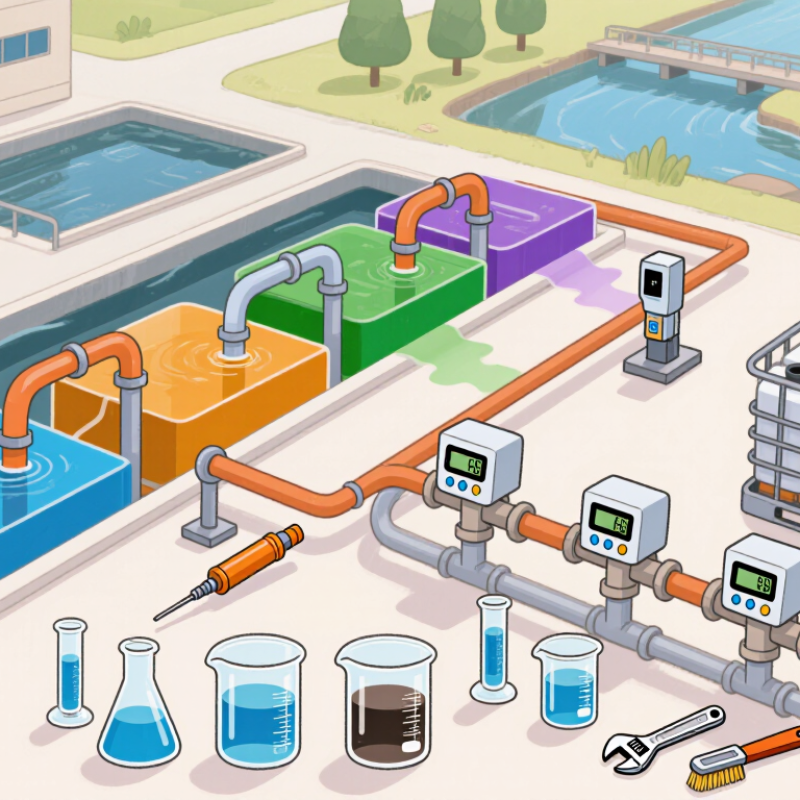
How to Choose Chemical Dosing for Wastewater Treatment

Wastewater Characteristics That Determine Chemical Dosing Requirements

Chemical dosing begins with wastewater, not a catalog. Its pH, alkalinity, temperature, turbidity, and pollutant load shape every dose. The UN World Water Development Report 2017 estimated that over 80% of global wastewater enters the environment without adequate treatment. That figure highlights why reliable characterization matters. A grab sample alone can mislead operators.

Alkalinity controls how much coagulant or pH-adjusting chemical the process can absorb. Low alkalinity may cause rapid pH decline after dosing. High suspended solids can increase coagulant demand, while soluble phosphorus may require a different strategy. The U.S. EPA Nutrient Control Design Manual links chemical phosphorus removal with wastewater chemistry, mixing, and molar dosing ratios. Jar tests should measure the actual water, not yesterday’s assumptions. Small details matter, such as a stormwater-driven dilution at 9 a.m.

Temperature also changes performance. The EPA manual notes that nitrification becomes slower in colder conditions. Therefore, a fixed chemical dose may fail during winter or heavy rainfall. Operators should track flow, pH, alkalinity, orthophosphate, COD, and TSS together. Online sensors help, but they still require calibration. Sensors drift. I have seen clean-looking data hide sampling errors.

A practical dosing plan uses baseline tests, jar testing, and controlled adjustment. Record chemical residuals and sludge volume after each change. Overdosing can raise operating costs and increase sludge production. Underdosing can release pollutants downstream. The uncomfortable truth is that no universal dose exists. Wastewater changes hourly. The dosing strategy must change with it.

How to Choose Chemical Dosing for Wastewater Treatment

Wastewater Characteristics That Determine Chemical Dosing Requirements

Higher suspended solids, phosphorus, turbidity, and alkalinity demand generally require increased coagulant or polymer dosing. The values shown are realistic illustrative operating ranges for municipal wastewater treatment and should be confirmed through jar testing, laboratory analysis, and process monitoring before design or operation.

Selecting Chemicals for Specific Treatment Objectives

Choosing chemicals begins with the treatment objective, not the storage room. A plant removing suspended solids may need a coagulant and polymer, while ammonia control requires a different process. I start by reviewing influent variability, pH, alkalinity, temperature, and target discharge limits. Small details matter. A cold morning can change floc formation and settling speed.

For phosphorus removal, iron- or aluminum-based coagulants can bind soluble phosphorus into settleable solids. The dose depends on phosphorus concentration, alkalinity, competing contaminants, and sludge handling capacity.

For pH correction, I select an agent based on the required adjustment and mixing conditions. Oxidants may reduce color or odor, but they can create unwanted byproducts when contact time is poorly controlled. Measure the change.

Bench jar tests provide a useful starting point, yet one test cannot represent an entire week. I compare several doses, settling times, filtrate clarity, residual chemical, and sludge volume. Operators should verify results with laboratory data and controlled field trials before changing full-scale settings. A cheap chemical can become expensive through excess sludge, pump wear, or repeated corrections. The difficult part is admitting that yesterday’s successful dose may fail after a storm or production change.

Calculating Dosage Rates from Flow and Water Quality Data

How to Choose Chemical Dosing for Wastewater Treatment

Chemical dosing should begin with measured flow and water quality, not a fixed pump setting. The basic metric formula is:

chemical demand (kg/day) = flow (m³/day) × dose (mg/L) ÷ 1,000

For example, a 2,400 m³/day flow at 35 mg/L requires 84 kg/day of active chemical. If the supplied solution contains 40% active material, the required solution mass becomes 210 kg/day. Check density before converting this value into litres.

The U.S. EPA Chemical Precipitation Fact Sheet recommends jar testing because wastewater chemistry changes chemical performance. Its guidance highlights the effects of pH, alkalinity, suspended solids, and mixing conditions.

The EPA Nutrient Control Design Manual also links phosphorus removal performance with site-specific testing rather than universal dosage tables.

A practical trial could test 20, 30, 35, and 45 mg/L while measuring final phosphorus, turbidity, and sludge volume.

Small differences matter.

Use daily composite samples where possible. Instant samples can mislead operators during peak discharge periods. A 10% flow-meter error creates roughly a 10% dosing error. That sounds simple. It is not always simple. I would review the calculation after rainfall, industrial discharge changes, or chemical-strength variation. The Water Environment Federation’s design guidance supports continuous adjustment, but field data still deserve skepticism. A clean spreadsheet cannot repair poor sampling.

Adjusting Dosing Systems Through Testing and Process Monitoring

Chemical dosing should be adjusted through evidence, not habit. Start with jar tests using fresh influent samples, because yesterday’s dose may not suit today’s chemistry. Measure turbidity, pH, alkalinity, nutrients, and residual chemicals before changing pump settings. UN-Water’s 2017 World Water Development Report estimated that more than 80% of global wastewater is released without adequate treatment. That figure makes process control more than an efficiency exercise.

Online sensors show direction, but laboratory samples confirm reality. Compare sensor readings with accredited laboratory results and record temperature, flow, rainfall, and chemical strength. The U.S. Environmental Protection Agency reports that energy can account for 25–40% of water and wastewater utility operating costs. Stable dosing can support lower mixing and pumping demand, although the relationship is site-specific. Calibrate probes regularly. Dirty sensors create confident mistakes.

A practical adjustment uses a dose-response curve. Test three or four doses, then select the lowest dose that consistently meets the required treatment target. Use flow-paced control during normal conditions, with automatic limits for sudden peaks. After heavy rain, increase sampling instead of immediately increasing chemicals. We once treated a rising turbidity trend as a dosing failure; the real cause was a drifting sensor. That mistake was expensive. It also proved why operators should verify alarms with grab samples, inspect pumps, and review settling behavior before changing the setpoint. Record every adjustment, including the reason and result.

How to Choose Chemical Dosing for Wastewater Treatment - Adjusting Dosing Systems Through Testing and Process Monitoring
Process Objective Chemical Type Key Feed-Water Indicator Typical Starting Dose Recommended Testing and Frequency Online Monitoring Signal Adjustment Guidance
Suspended-solids and turbidity removal Aluminum-based coagulant Turbidity, total suspended solids, alkalinity, pH 10–100 mg/L as product Jar testing for each significant change in influent quality; verify settled-water turbidity at least once per shift Raw-water turbidity, rapid-mix pH, settled-water turbidity Increase dose only when jar-test results show improved removal. If pH falls outside the effective range, correct alkalinity or adjust pH before increasing coagulant.
Suspended-solids and phosphorus precipitation Ferric salt Orthophosphate, soluble phosphorus, alkalinity, pH 1.5–2.5 mol Fe per mol P as an initial test range Bench or jar testing during commissioning and after major load changes; phosphorus analysis daily or as required by the permit Effluent orthophosphate, oxidation-reduction potential, pH, sludge blanket level Use the lowest dose that consistently meets the phosphorus target. Watch for excess chemical consumption, lower pH, and increased sludge production.
Floc formation and clarification Water-soluble polymer Floc size, settling rate, sludge characteristics, shear conditions 0.1–5 mg/L active polymer Jar testing and visual floc inspection daily during optimization; check polymer solution concentration and aging time Clarifier effluent turbidity, solids blanket depth, sludge-flow rate Optimize polymer type, dilution, mixing energy, and injection point before increasing dose. Excess polymer may produce slimy floc and poor dewatering.
pH neutralization before biological or discharge treatment Acid or alkaline reagent Influent pH, alkalinity, acidity, flow rate, chemical strength Calculated from titration; confirm with a controlled step test Continuous pH measurement with grab-sample verification at least daily; calibrate probes according to the site procedure Inlet and outlet pH, flow-paced chemical feed, high/low pH alarms Use flow-paced control with trim from the downstream pH signal. Avoid rapid overcorrection by applying a suitable control delay and mixing time.
Biological nitrogen removal support Alkalinity supplement Ammonia, nitrate, nitrite, alkalinity, biological-process pH Approximately 7.14 mg alkalinity as CaCO3 per mg ammonia-nitrogen oxidized Measure ammonia, nitrate, nitrite, alkalinity, and pH during process changes; increase testing during cold-weather or high-load periods Ammonia and nitrate analyzers, aeration-basin pH, dissolved oxygen Base the dose on measured alkalinity demand rather than ammonia concentration alone. Maintain stable pH and alkalinity to protect nitrification.
Denitrification and nitrate reduction Readily biodegradable external carbon Nitrate, nitrite, influent biodegradable carbon, anoxic-zone dissolved oxygen Determine by carbon-to-nitrate testing; avoid using a fixed universal ratio Nitrate and nitrite testing daily during adjustment; conduct a controlled dose-response test before permanent changes Anoxic-zone nitrate, oxidation-reduction potential, dissolved oxygen, final effluent nitrogen Increase gradually when nitrate remains high and carbon is limiting. Reduce the dose if residual carbon, rising effluent COD, or excessive biomass is observed.
Final effluent disinfection Chlorine-based disinfectant Flow, ammonia, organic demand, temperature, contact time Set by demand testing and required disinfectant residual; commonly 1–10 mg/L applied chlorine Chlorine-demand testing during seasonal and load changes; measure residual at the required compliance location Flow, contact-tank residual, oxidation-reduction potential, contact time Control the feed using flow and residual feedback. Confirm that baffling and contact time are adequate before increasing the chemical dose.
Dechlorination before discharge Sulfur-based reducing agent Residual chlorine, flow, chemical concentration, pH Dose based on measured oxidant residual and stoichiometric demand; verify with field testing Residual chlorine testing at least once per shift during stable operation and more frequently during process changes Residual chlorine, flow-paced feed, oxidation-reduction potential Maintain the lowest dose that reliably removes residual chlorine. Excess reducing agent can reduce dissolved oxygen and add unnecessary chemical demand.
Sludge conditioning before dewatering Cationic or amphoteric polymer Sludge solids concentration, volatile solids, capillary suction time, filtrate quality 2–10 kg active polymer per tonne of dry solids Bench dewatering tests before each major sludge change; verify cake solids and filtrate clarity during operation Feed-solids concentration, filtrate turbidity, cake solids, press or centrifuge torque Adjust dose for dry-solids loading, not sludge volume alone. Optimize mixing intensity and polymer dilution before increasing the active dose.
Operating note: The stated ranges are practical starting points, not guaranteed setpoints. Final chemical selection and dose should be confirmed through representative jar tests, titration, pilot testing, safety review, and permit-specific monitoring. Chemical feed should be interlocked with flow, low-level alarms, leak detection, and high/low process-value alarms where appropriate.

Managing Safety, Compatibility, Cost, and Environmental Impacts

Chemical dosing in wastewater treatment requires more than selecting a product that removes pollutants quickly. Safety comes first. Operators should review the safety data sheet, confirm ventilation, and provide suitable gloves, face protection, spill control, and emergency washing facilities. Chemical storage tanks need secondary containment, clear labels, and separation between incompatible substances.

Compatibility also affects reliability. A chemical may react with tank materials, seals, tubing, or other treatment chemicals. Before full-scale dosing, engineers should run jar tests and inspect small equipment sections. They should measure pH, temperature, mixing performance, and residual concentration. Small errors matter. A dosing pump that drifts by a few percent can change effluent quality and increase sludge production.

Cost should include more than the purchase price. Transport, storage, energy, maintenance, disposal, and operator training can change the final calculation. Environmental impacts deserve equal attention. Lower chemical demand may reduce sludge, truck movements, and residual toxicity, but it is not automatically the best option. Field conditions vary. A spreadsheet can mislead when wastewater composition changes after rainfall or industrial discharge. Online sensors help, yet operators must verify readings with laboratory tests. I would also review dosing performance regularly, because a system that worked last season may now waste chemicals or create avoidable environmental risks.

FAQS

What wastewater properties determine chemical dosing needs?

pH, alkalinity, temperature, turbidity, flow, COD, TSS, and phosphorus all affect dosing. Small changes matter.

Why is alkalinity important during chemical dosing?

Alkalinity helps wastewater resist pH changes after chemical addition. Low alkalinity can cause a rapid pH decline.

Can one fixed chemical dose work throughout the year?

Usually not. Temperature, rainfall, industrial discharge, and pollutant loads can change hourly. Winter conditions may slow biological treatment.

How is the daily chemical demand calculated?

Use this formula: chemical demand equals flow times dose, divided by 1,000. For 2,400 m³/day at 35 mg/L, demand equals 84 kg/day.

How should solution strength affect the calculation?

A 40% active solution requires 210 kg/day to provide 84 kg/day of active chemical. Check solution density before converting kilograms into litres.

Why are jar tests necessary?

Jar tests show how actual wastewater responds to different doses and mixing conditions. Test several levels, such as 20, 30, 35, and 45 mg/L.

What should operators measure during a dosing trial?

Measure final phosphorus, turbidity, pH, residual chemical, and sludge volume. Record each result after every adjustment.

Are online sensors always reliable?

No. Sensors can drift or report clean-looking data after poor sampling. Calibrate them regularly and compare readings with laboratory tests.

What sampling method gives better dosing information?

Daily composite samples often represent changing wastewater better than one grab sample. A stormwater dilution at 9 a.m. can distort a single result.

What happens when chemical dosing is too high or too low?

Overdosing increases chemical costs and sludge production. Underdosing may leave pollutants in the treated water. No universal dose exists.

Conclusion

Choosing the right chemical dosing strategy is essential for achieving reliable wastewater treatment results. Why is chemical dosing important in wastewater treatment? It helps control pollutants, adjust pH, support coagulation and flocculation, remove nutrients, reduce odors, and meet required water quality targets. The correct approach begins with evaluating wastewater characteristics such as flow rate, pH, suspended solids, organic load, temperature, and contaminant levels. Chemicals should then be selected according to the specific treatment objective, while dosage rates are calculated from accurate flow and water quality data.

Effective dosing also requires regular testing and process monitoring. Operators can adjust dosing pumps and control settings based on laboratory results, online measurements, and changes in wastewater conditions. Safety, chemical compatibility, storage requirements, operating cost, sludge production, and environmental impacts must be considered throughout the process. A balanced dosing program improves treatment performance, avoids unnecessary chemical use, supports stable operations, and promotes more sustainable wastewater management.

Isabella

Isabella

Isabella is a dedicated marketing professional with a sharp focus on driving brand growth and engagement through strategic content creation. With an extensive background in digital marketing, she combines her passion for storytelling with her keen understanding of industry trends to deliver......